A memo for the CIO/CTO office, CPOs and business owners on turning a long list of possible quantum use cases into two or three that deserve a funded evaluation.
Summary
A business problem becomes a quantum use case once three things are established: an outcome worth improving, evidence that computation limits that outcome, and a credible reason to test a quantum method alongside the best classical ones.
A five-stage filter takes around thirty ideas down to two or three that business leaders can challenge and own:
- Exposure: which decision would improve, who owns it, and what minimum improvement would change what the business does;
- Constraint: whether computation is the real bottleneck, or data, process or user trust;
- Qualification: whether the problem’s structure, size and data profile suit quantum methods;
- Baseline: what the best classical method already delivers;
- Ranking: value, readiness and the cost of resolving the next uncertainty, with stop criteria agreed in advance.
Every candidate leaves the filter with a recorded outcome: funded, redirected, deferred or stopped. Many will end with a better classical answer. That is a gain the business can book this year, reported as a classical gain.
Situation: the list arrives before the problem
The request sounds simple: find where quantum computing could create value for the business. A workshop produces a familiar list. Portfolio optimisation. Fraud detection. Routing. Production scheduling. Materials discovery. Each item has a plausible link to the company, and each appears in a supplier presentation or an analyst report.
Then someone asks which one should receive funding, and the list offers little help.
Complication: a use case is only a label until it has an owner, a constraint and a baseline
“Production scheduling” can describe dozens of decisions, each with its own constraints, data and economics. Even within one factory, the problem that interests a researcher may differ from the one that occupies the production manager.
Three gaps make generic lists impossible to rank. Most items have no business owner whose KPI would move. Few have a value mechanism: which decision changes, how often, and what the improvement is worth. Almost none has a documented baseline, so any new method looks like progress.
There is also a technical gap. Published analyses point to a narrow profile where quantum computers can realistically help: compact inputs, heavy computation, and a speedup large enough to survive the overheads of error-corrected hardware [1][2]. Many items on a typical list fail this test on paper, in an afternoon review.
Resolution: five stages, each with a recorded outcome
Business owners define useful outcomes, specialists test quantum relevance, and finance challenges the value assumptions within the existing investment review.
Exhibit 1. From thirty ideas to two funded evaluations
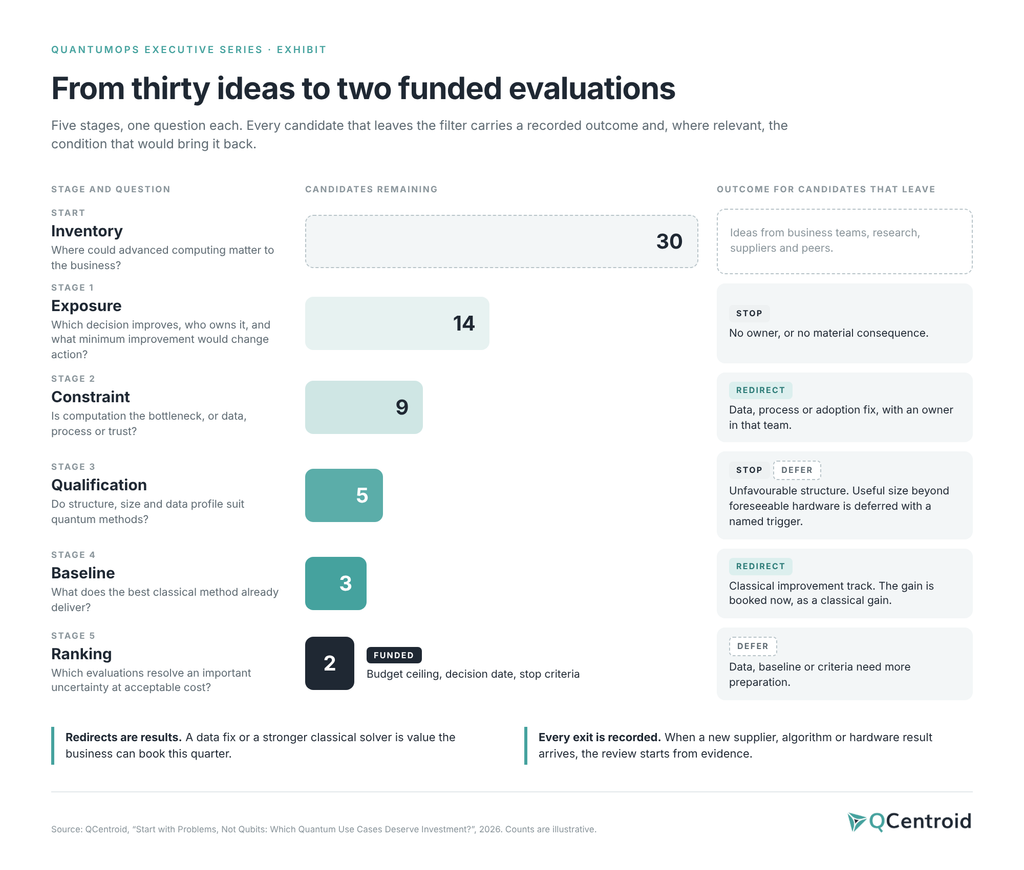
Alt text: Five-stage filter narrowing 30 quantum use-case ideas to 2 funded evaluations, with the outcome (stop, redirect, defer or funded) recorded at each stage.
1. Exposure: start with the people accountable for the outcome
Ask business owners where they accept compromises because a calculation takes too long, costs too much or produces an answer of insufficient quality. Which scenarios do they leave unexplored? Which assumptions do they simplify to meet a deadline? A risk team may exclude scenarios to finish an overnight run. A research team may rely on an approximation that blurs the difference between promising materials.
Then ask the question that sets the bar: if this improvement were available tomorrow, what would the business do differently? The answer defines the minimum useful improvement, agreed before any technical work begins. A problem with no accountable owner needs more discovery before it receives a budget.
2. Constraint: confirm that computation is what holds the decision back
A slow decision can have many causes. Data may arrive late, approvals may take days, or users may override recommendations they do not trust. Trace the workflow with the business owner, a domain specialist and someone who knows the current implementation.
Exhibit 2 shows an illustrative scheduling problem in two plants. In Plant A, the solver runs for twenty minutes and assembling its inputs takes two days, so the candidate goes to the data or process owner. In Plant B, inputs arrive automatically and the twenty-minute run is what stops the team from replanning after a disruption.
Exhibit 2. Is computation the constraint?
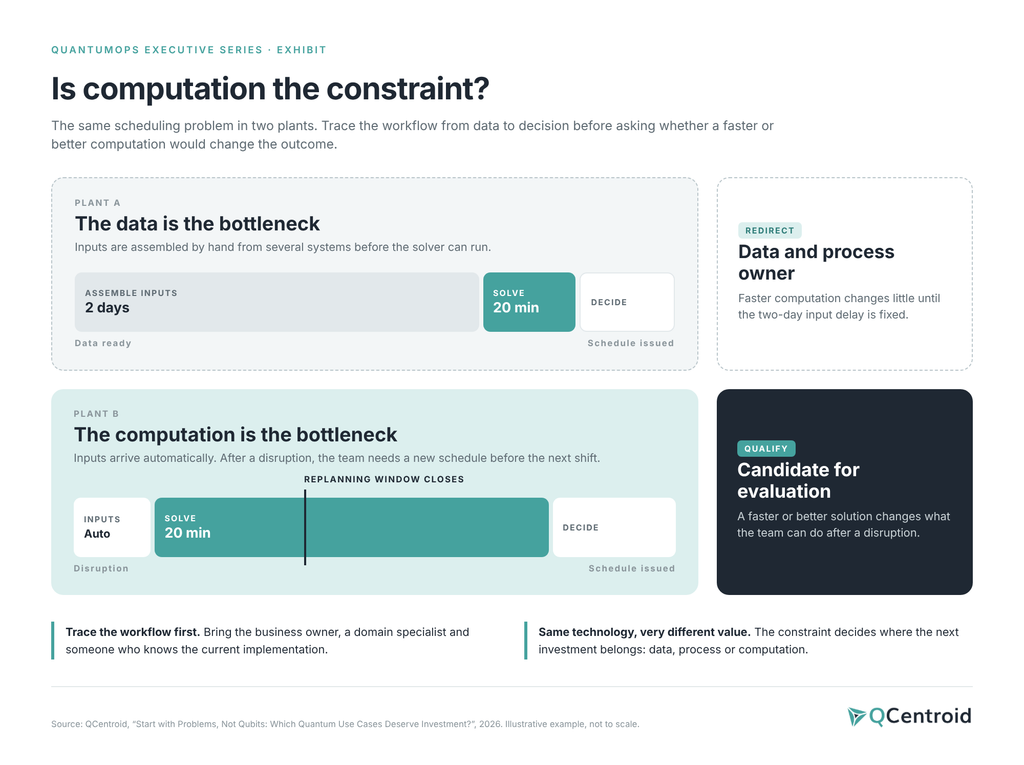
Alt text: The same scheduling problem in two plants: where input preparation takes two days the case is redirected to data owners; where the solver blocks replanning it qualifies for evaluation.
3. Qualification: test whether quantum deserves a place in the comparison
A label such as “optimisation” leaves the key questions open. The technical team should state which part of the workload a quantum method would address and why it might help. Four checks do most of the work:
- Problem class: combinatorial optimisation, sampling and Monte Carlo estimation, quantum simulation in chemistry and materials, or specific linear-algebra tasks.
- Data profile: compact inputs with heavy computation are favourable. Large data volumes that must be loaded into the machine are a warning sign.
- Size that matters: the problem size at which business value appears, compared with credible resource estimates for current and future hardware [3].
- Answer quality: whether a good approximate answer delivered on time is useful to the business.
Management needs the result in plain language: the hypothesis, the evidence behind it, the main uncertainty and the cost of resolving it. Where useful performance depends on future hardware, the candidate is deferred, with the required capability written down as its trigger.
4. Baseline: measure the best classical answer first
Compare each remaining candidate with the current method and with credible improvements to it: a stronger solver, a revised formulation, GPU acceleration, HPC or an AI-assisted method. Record solution quality, runtime, end-to-end cost and the manual interventions users make today.
This stage often produces the most valuable finding of the exercise. A ten-year-old scheduling heuristic may improve by several percent with a modern solver configured by a specialist. That gain moves to a classical improvement track, is booked now and is reported under its real source. The formulation is kept for re-testing as quantum hardware matures.
5. Ranking: fund the evaluations that resolve an important uncertainty
Score the remaining candidates on the importance of the outcome, the readiness of data and baseline, the strength of the technical hypothesis, and the cost of resolving the next uncertainty. Reusable outputs, such as a validated formulation or a representative test set, add weight.
Keep the judgement visible. A high total score can hide a missing owner or inaccessible data, so treat those as conditions to clear before funding. Each funded evaluation gets a budget ceiling, a time limit, a decision date and stop criteria agreed in advance. Two well-qualified candidates are enough, and an empty shortlist is a defensible outcome when the evidence supports it.
What the CIO office should bring to the investment discussion
Each shortlisted problem reaches the investment discussion on one page, structured as in Exhibit 3. Keep expected business value and demonstrated technical performance on separate lines. The first explains why the problem matters. The second records what has been shown so far.
Exhibit 3. The one-page investment brief
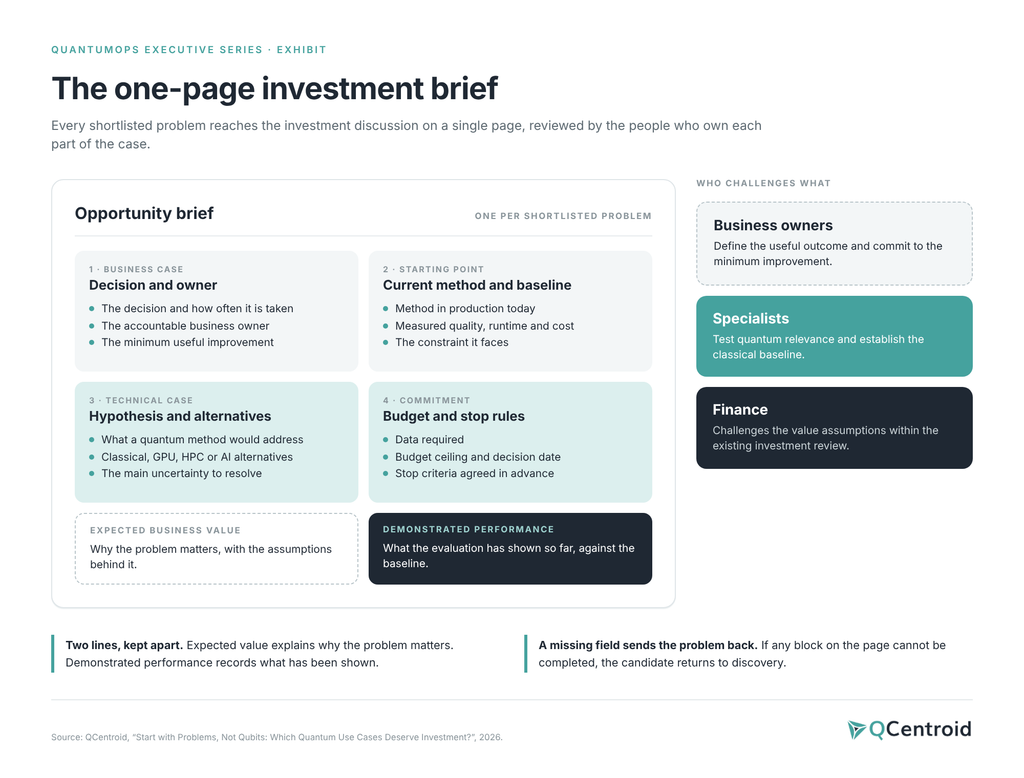
Alt text: One-page quantum investment brief with four blocks (decision and owner, current method and baseline, hypothesis and alternatives, budget and stop rules) and the roles of business owners, specialists and finance.
What this memo does and does not claim
The sectors and problem types named here show where to look. They carry no claim of demonstrated quantum advantage, which has to be established workload by workload. The filter stays useful whichever way the evidence moves, because it records why each idea was funded, redirected, deferred or stopped.
Actions for the next quarter
- Build the problem inventory. Owner: CIO/CTO office, with selected business owners. Capture each decision, its owner, its limitation and the minimum useful improvement.
- Qualify and baseline the candidates. Owner: chief architect or head of data science, with domain specialists. Record the outcome and the reason for every candidate.
- Approve a small evaluation portfolio. Owner: executive sponsor, with business owners and finance. Fund up to three evaluations, each with a budget ceiling, a decision date and stop criteria, and book classical gains as classical.
The test at the next review is simple. Any sponsoring business owner can name, within a minute, the decision their opportunity improves, the baseline it must beat, the threshold that would change what they do and the conditions under which the work stops. Every other idea from the original list sits on file with its outcome, ready for the next supplier pitch or hardware result.
Part of the QuantumOps Executive Series by QCentroid: practical guidance for leaders building a repeatable, evidence-based and governed approach to advanced computing.
Sources
- [1] Torsten Hoefler, Thomas Häner and Matthias Troyer, Disentangling Hype from Practicality: On Realistically Achieving Quantum Advantage, Communications of the ACM, May 2023.
- [2] Ryan Babbush et al., Focus beyond Quadratic Speedups for Error-Corrected Quantum Advantage, PRX Quantum, 2021.
- [3] DARPA, Quantum Benchmarking programme: application-specific benchmarks and hardware resource estimates.
Web version: search and publishing notes (remove from the memo)
- Meta description: How to turn thirty quantum use-case ideas into two or three worth funding: a five-stage filter covering ownership, constraint, quantum fit and baseline.
- Web H2 for the Resolution section: How to identify quantum use cases worth funding: a five-stage filter
- Schema: Article markup with a named author, publisher (QCentroid), datePublished and dateModified. Publish the exhibits as images with the alt text above. No FAQPage markup.
- Hero image: Exhibit 1.
- Outreach and LinkedIn hook: Thirty possible quantum use cases, three worth funding. Here’s the filter. Lead the email with Exhibit 2.
Frequently asked questions
How do you identify enterprise quantum use cases?
Start from important business decisions that computation limits, each with a named owner and a minimum useful improvement, and confirm that computation is the real bottleneck. Then test whether the problem’s structure, size and data profile suit quantum methods, measure the best classical baseline, and fund only the two or three candidates that resolve an important uncertainty at acceptable cost.
When should a company use classical optimisation instead of quantum computing?
When a stronger solver, a revised formulation, GPU acceleration or HPC already delivers the minimum useful improvement, the business should adopt it and report the gain as a classical gain. The problem formulation is kept, so the comparison can be repeated as quantum hardware matures.
What should a one-page quantum investment proposal include?
The decision, its owner and the minimum useful improvement; the current method, its baseline and the constraint it faces; and the technical hypothesis with the alternatives to compare. It should also state the data required, the budget ceiling, the decision date and the stop criteria, with expected business value kept separate from demonstrated performance.