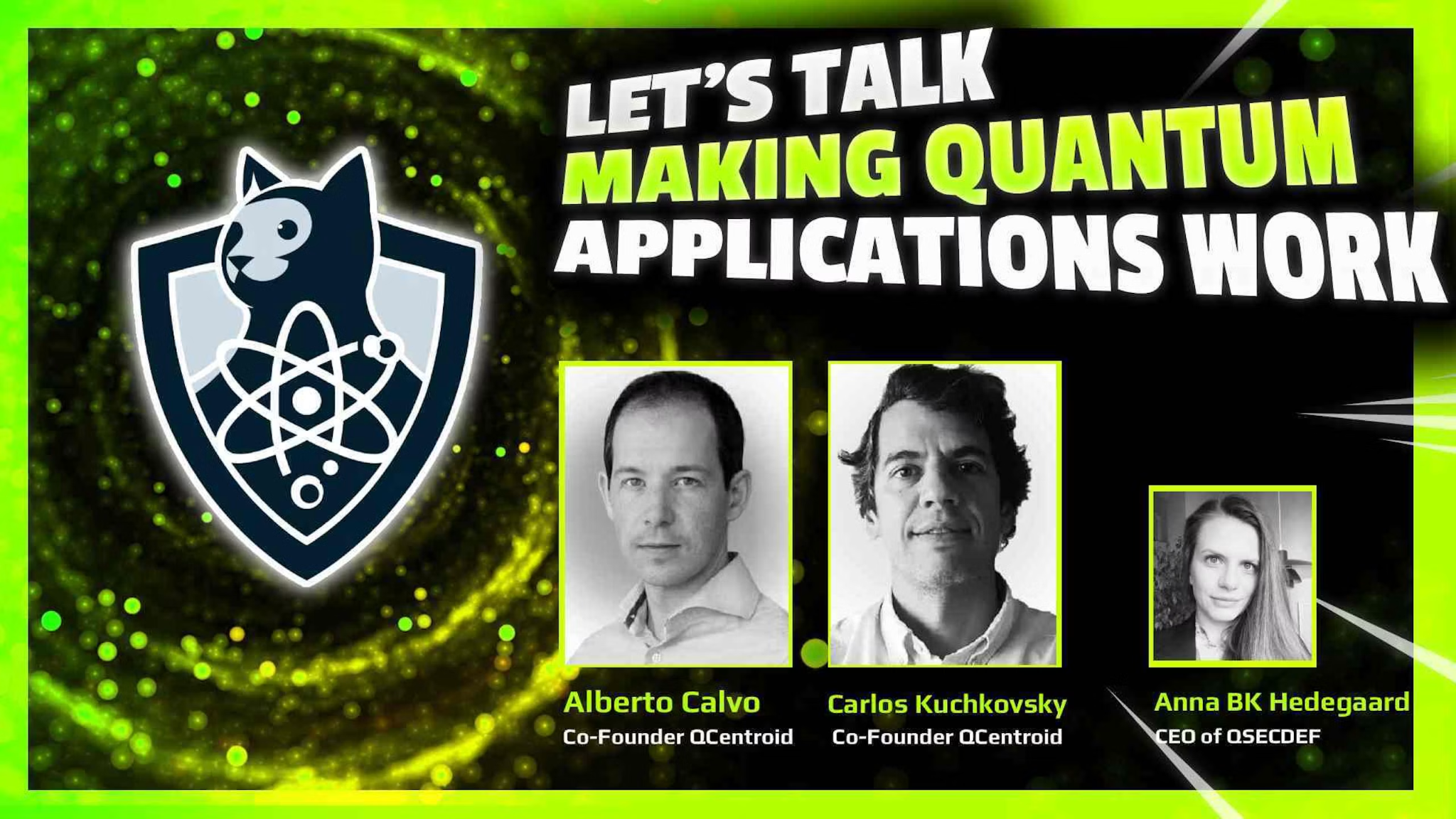
On 29 September 2026, QCentroid co-founders Carlos Kuchkovsky (CEO) and Alberto Calvo (CTO) presented QuantumOps to the Quantum Security Defence (QSECDEF) community. This article sets out the argument they made and what the live demo on the QCentroid platform showed.
Defence organisations have spent the last few years preparing for quantum as a threat. Post-quantum cryptography now has standards, crypto inventories and migration roadmaps.
The other half of the mandate gets far less attention. How does a defence organisation put quantum computing to work on its own problems, and how does it know when the evidence justifies the investment?
That question shaped QCentroid’s session at the QSECDEF webinar. Carlos Kuchkovsky and Alberto Calvo covered where quantum computing has a credible case today, what allied programmes ask of every quantum initiative, and how the QuantumOps method turns those requests into a repeatable process. The session closed with a live demo and an open Q&A with the QSECDEF community.
Anna Beata Kalisz Hedegaard, Co-Founder and CEO of QSECDEF, opened the session and introduced the speakers. QCentroid thanks Anna and Steve Vaile for welcoming QCentroid into the QSECDEF community, and for the work both do to move quantum forward in the security space.
Quantum advantage will be earned problem by problem
QCentroid’s view is that quantum advantage will be proven one problem at a time, against the best classical method, on cost, quality, speed and energy.
The session placed defence and dual-use problems in three families, each at a different level of maturity.
| Problem family | Defence and dual-use examples | Status in 2026 |
| Optimisation | Mission and logistics planning, sensor-to-target assignment, spectrum allocation, maintenance scheduling | Value today, mainly through quantum-inspired and hybrid solvers benchmarked against strong classical baselines |
| Simulation | Energetic materials, battery electrolytes, radar-absorbing coatings, propellants, catalysts | Strongest theoretical case; the largest impact needs fault-tolerant hardware |
| Machine learning | Anomaly detection on sensor feeds, signal classification, generative models for rare events | Research stage; benchmark and learn before deploying |
In every family, quantum computing arrives inside a hybrid stack. Quantum processors run next to HPC, GPUs and AI, and near-term claims of advantage depend on that combination.
Allied programmes all ask for proof
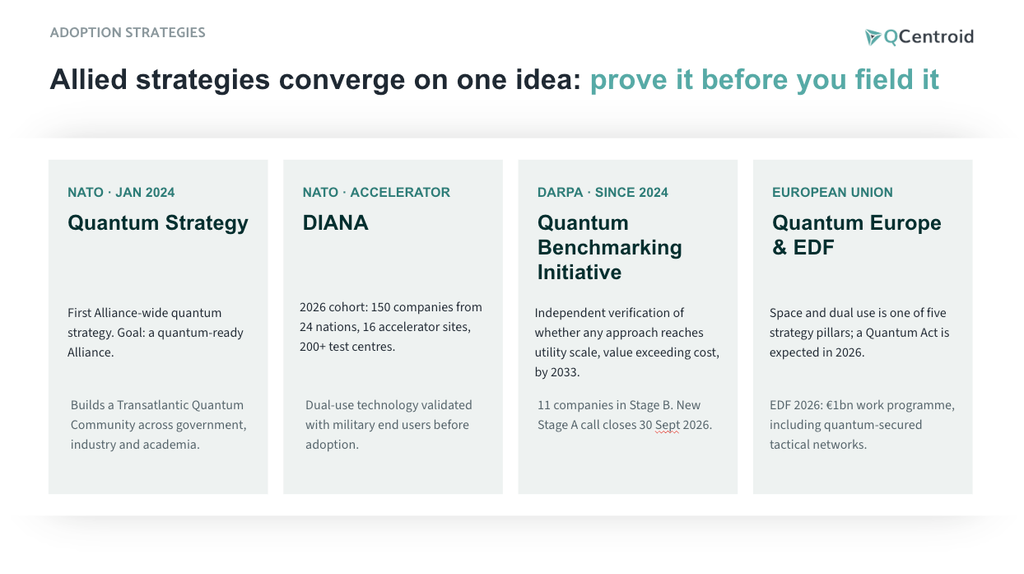
NATO’s Quantum Strategy, NATO’s DIANA accelerator, DARPA’s Quantum Benchmarking Initiative and the EU’s Quantum Europe strategy with the European Defence Fund all invest in quantum. Each one starts by demanding evidence.
Across these programmes, four requirements repeat:
- Independent benchmarking. Claims are verified on the organisation’s own problem.
- Validation with end users. Technology is tested in mission-relevant conditions before procurement.
- Sovereignty. Sensitive data, models and results stay under national or European control.
- Readiness before bets. Use cases, baselines and skills are built now, and hardware commitments come later.
These are operational requirements. Meeting them consistently needs an operations layer.
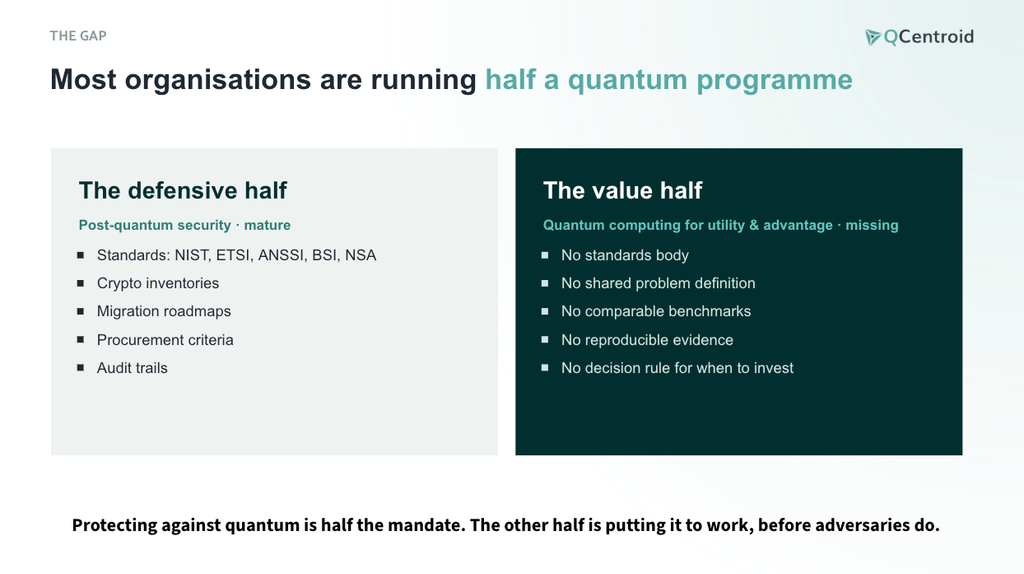
Most organisations run half a quantum programme
The defensive half of a quantum programme is mature. Standards from NIST, ETSI, ANSSI, BSI and NSA exist, along with crypto inventories, migration roadmaps, procurement criteria and audit trails.
The value half, using quantum computing for operational advantage, is largely missing. There is no shared problem definition, no comparable benchmark, no reproducible evidence and no decision rule for when to invest.
Protecting against quantum covers half the mandate. The other half is putting quantum computing to work before adversaries do.
The target moves faster than procurement
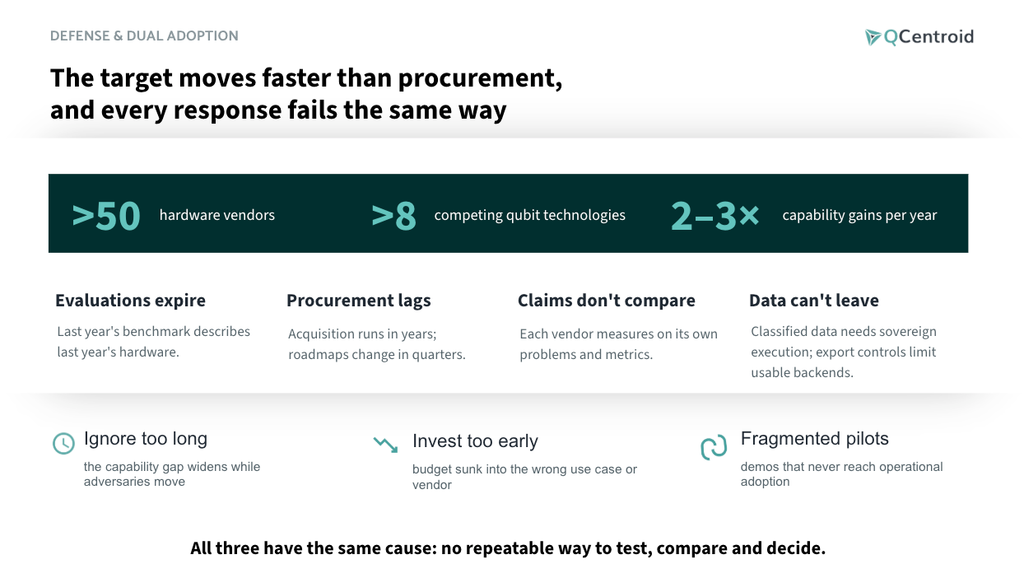
Quantum hardware changes faster than defence acquisition. Roadmaps shift in quarters, while procurement runs in years. A benchmark from last year describes last year’s machines.
Vendor claims rarely compare, because each vendor measures on its own problems and metrics. Classified data needs sovereign execution, and export controls limit which backends an organisation can use.
The session described three common responses, and all three fail the same way:
- Ignoring quantum for too long widens the capability gap.
- Investing too early sinks budget into the wrong use case or vendor.
- Fragmented pilots produce demos that never reach operational adoption.
The shared cause is the absence of a repeatable way to test, compare and decide. QCentroid’s answer is to build the capacity to re-decide, with three components:
- A portfolio of ranked candidate problems, each tied to an operational KPI.
- A baseline, meaning a classical result to beat and one data contract, so every algorithm and backend is compared the same way.
- A decision rule of integrate, hold or wait, re-evaluated whenever the hardware moves.
QuantumOps, the missing operations layer
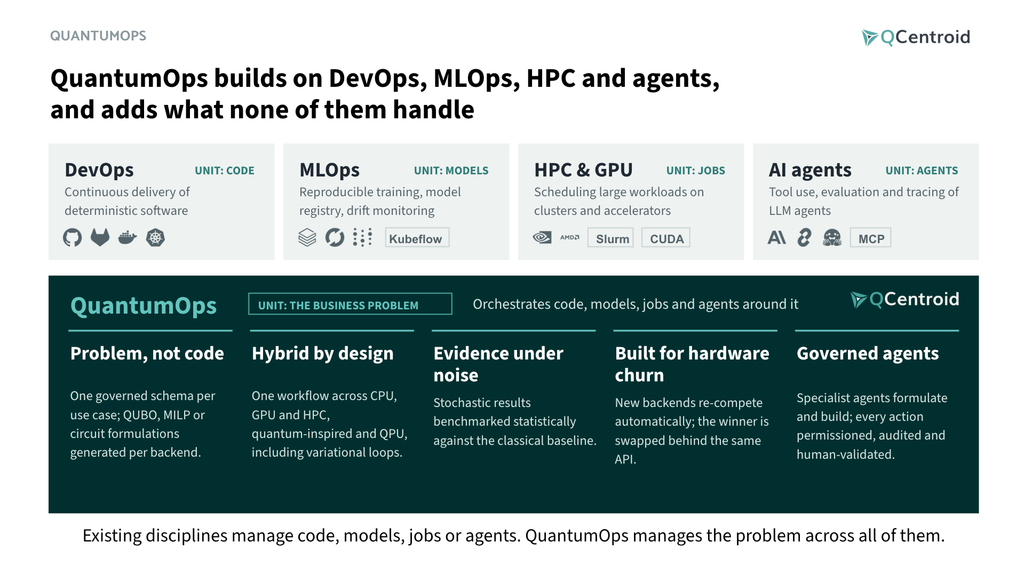
QuantumOps is QCentroid’s method for running quantum adoption as a continuous engineering process. DevOps manages code, MLOps manages models and HPC schedulers manage jobs. QuantumOps manages the business problem across all of them.
In practice, QuantumOps rests on five principles:
- Problem first. Each use case has one governed definition, and the formulation for each backend is generated from it.
- Hybrid by design. One workflow spans CPU, GPU, HPC, quantum-inspired solvers and quantum processors.
- Evidence under noise. Results from quantum hardware vary run to run, so they are benchmarked statistically against the classical baseline.
- Built for hardware churn. New backends compete on the same problem, and a better solver is swapped in behind the same API.
- Governed agents. Specialist AI agents help formulate and build use cases, with every action permissioned, audited and validated by a person.
What the live demo showed
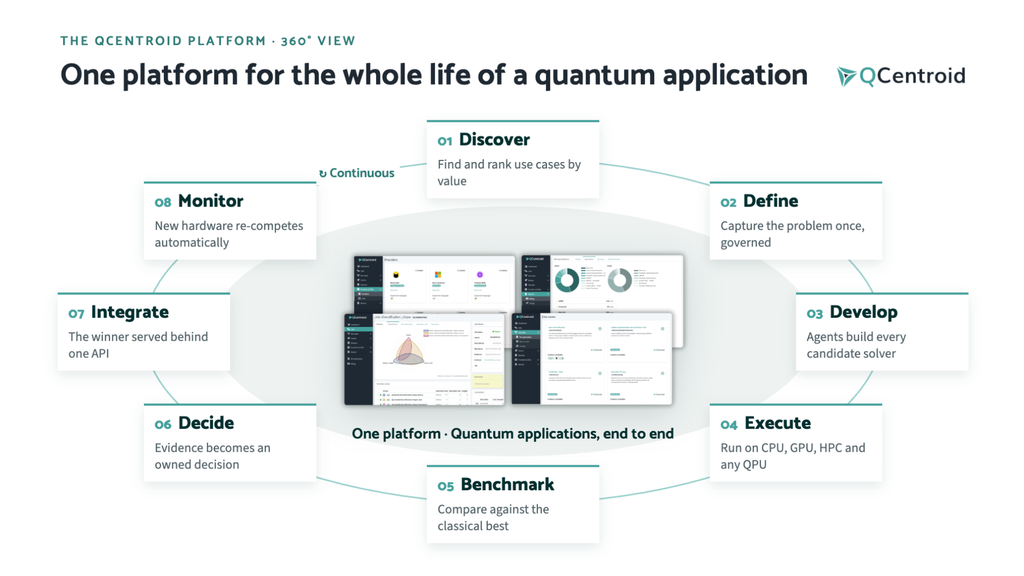
The demo walked a defence-relevant use case through the QCentroid platform, from an operational goal to a decision. Everything below was shown live and is available on the platform today.
- Discover. A discovery assistant takes an organisation’s sector and operational goals, proposes candidate use cases and produces feasibility reports with links to research papers.
- Prioritise. A portfolio and roadmap view ranks use cases by impact and by how soon they are likely to be feasible.
- Build and execute. Each solver pairs an algorithm with a hardware provider, across classical CPUs, GPU-accelerated environments and quantum hardware. Standardised inputs and outputs keep every solver working on the same problem definition.
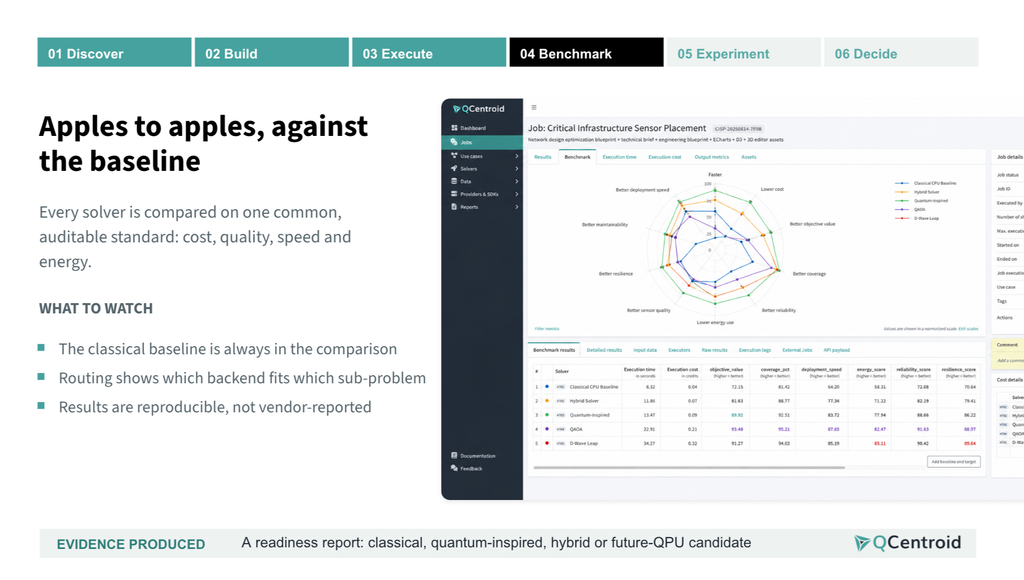
- Benchmark. Three solvers ran on the same use case and were compared side by side on metrics defined for that use case, such as time, solution quality and cost.
- Decide. The evidence supports one of three outcomes. Integrate means deploy through the API and keep benchmarking new backends. Hold means promising but not yet better, so monitor on a schedule. Wait means classical wins today, so revisit when the hardware moves.
Sovereign by design
For defence users, where the platform runs matters as much as what it does. QCentroid offers three deployment options.
| Option | Where it runs | Data | Typical use | Status |
| Managed SaaS | Operated by QCentroid in a European region | Synthetic or non-sensitive | Discovery Pilots | Available today |
| Private or sovereign cloud | Single tenant in the customer’s cloud account or a sovereign European cloud | Stays in the customer’s tenant | Enterprise programmes | Configuration or integration required |
| On-premise | Installed in the customer’s data centre, operated by the customer’s team | Never leaves the customer’s perimeter; external quantum processors only if approved | Classified and regulated workloads | Configuration or integration required |
The same controls apply in every option: role-based access, a full audit trail, budget and cost limits, backend allow-lists for export control, and encryption at rest and in transit. Customer code stays in the customer’s own Git repository, and customers use their own hardware provider accounts.
Build the operations layer with us
If you are part of the QSECDEF community and want to build the operations layer for dual-use quantum in defence, contact Carlos Kuchkovsky at carlos@qcentroid.xyz.
Frequently asked questions
What is QuantumOps? QuantumOps is QCentroid’s method and platform for adopting quantum computing as a continuous process. It connects use cases, data, algorithms and hardware, benchmarks every option against the best classical method, and turns the evidence into a decision to integrate, hold or wait.
Does QCentroid claim quantum advantage for defence problems? No. QCentroid’s position is that advantage has to be proven on each problem against the best classical baseline. Where classical methods win, the QCentroid platform records that and schedules a re-test when new hardware arrives.
Can the QCentroid platform run where classified data lives? Yes. The on-premise option installs the QCentroid platform in the customer’s data centre, and data never leaves the customer’s perimeter. External quantum processors are used only if the customer approves them. This option requires configuration or integration work.
Which hardware does the QCentroid platform support? The QCentroid platform is hardware-agnostic. It runs workloads on classical CPUs, GPUs, HPC systems, quantum-inspired solvers and quantum processors from multiple providers, and customers use their own provider accounts.
Summary
On 29 September 2026, QCentroid presented QuantumOps to the Quantum Security Defence (QSECDEF) community in a webinar opened by QSECDEF Co-Founder and CEO Anna Beata Kalisz Hedegaard. QCentroid CEO Carlos Kuchkovsky and CTO Alberto Calvo argued that defence organisations have matured their defences against quantum threats but lack a repeatable way to prove where quantum computing adds value. Allied programmes from NATO, DIANA, DARPA and the EU all ask for independent benchmarking, validation with end users, sovereignty and readiness. The QCentroid platform answers with one governed problem definition per use case, side-by-side benchmarking across classical and quantum solvers, sovereign deployment options and an integrate, hold or wait decision that is re-tested as hardware evolves.